
From Standards to GeoAI Governance - ISPRS 2026
This blog summarizes the talk delivered by Dr. Nadine Alameh at ISPRS 2026 (July 2026, Toronto Canada) as part of a special session on ISO 19157-3 Data quality.
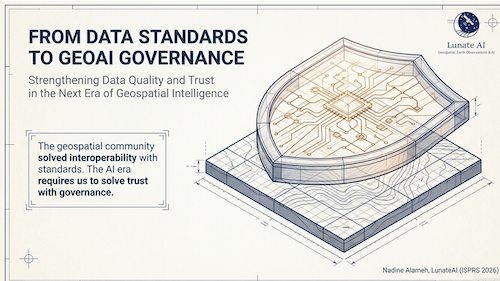
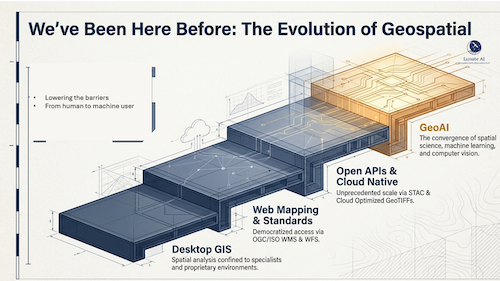
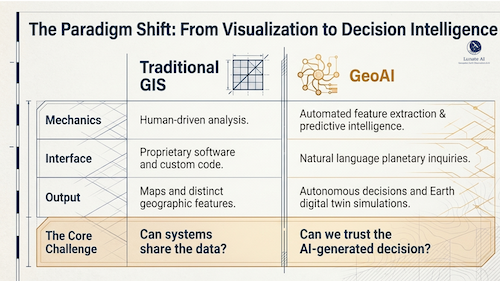
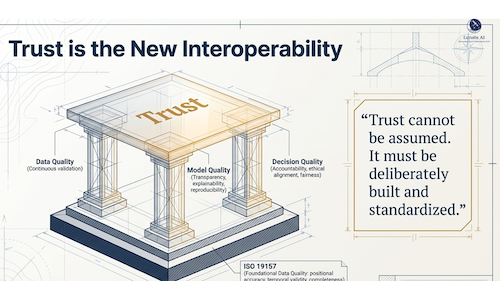
For decades, the geospatial community has successfully tackled the massive challenge of data interoperability through robust ISO and OGC standards. Today, as GeoAI transforms how we interact with geospatial information, the challenge is no longer just whether systems can exchange data—it is whether we can trust the AI-generated insights and decisions built upon it.
GeoAI marks a fundamental shift from visualization to decision intelligence. Instead of simply helping humans analyze maps, AI can now reason across vast volumes of planetary data, support natural language interactions, generate predictive insights, and automate complex workflows. These capabilities are already influencing critical domains such as disaster response, climate resilience, agriculture, biodiversity, and infrastructure management. Yet this new era introduces questions that traditional geospatial standards were never designed to answer: Where did an AI-generated answer come from? Can it be reproduced? Who is accountable for its outcomes? Most importantly, can it be trusted?
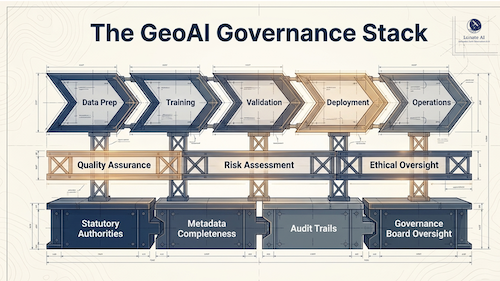
To address these challenges, governance must become the foundation of the GeoAI ecosystem. A robust framework should span the entire AI lifecycle—from data preparation and model training to deployment, monitoring, and ongoing oversight—while embedding principles such as transparency, explainability, accountability, and reproducibility.
Insights from the UK GeoAI Outlook reinforce a clear message: trust cannot be assumed; it must be deliberately built. As GeoAI evolves into a powerful decision-making system, organizations such as ISPRS have an opportunity to lead by advancing standards for governance, provenance, and decision quality. If the past decades were devoted to standardizing geospatial data, the next decade will be defined by standardizing trust.
